

Last updated on June 3rd, 2026 at 04:22 pm

Appalachian Trail Thru-Hike FAQs
Hi, I’m Cindy. My husband Barrett and I completed an Appalachian Trail thru-hike in 2022, covering every mile across 14 states in 32 weeks.
After we finished our thru-hike in 2022, questions kept coming from friends, family, and new hikers considering the trail.
Here are the most common questions I’m asked, answered honestly after 32 weeks and hiking the entire trail.
What is the Appalachian Trail (AKA the AT)?
The Appalachian Trail is a hiking-only footpath that follows the Appalachian Mountains throughout the eastern United States. It is just under 2,200 miles long and crosses through 14 states.
Every year, thousands of hikers attempt to cover the entire distance of the trail in 12 months or less, so they may claim the title of being an AT thru-hiker.
Do you need snow gear for the Appalachian Trail?
It depends on the months you are hiking and which parts of the trail.
I did not hike in the winter months. That said, we still encountered some cold weather at the beginning and end of our hike.
If I had hiked during the winter months, though, here are the items I would have looked into adding to my hike:
✅ A Better Puffy
✅ Waterproof Boots
✅ Microspikes
✅ Down Booties
✅ Tarp
(The tarp is worth adding to your kit if you plan on sleeping in the shelters to help keep the wind off you.)
What gear do you need for hunting season?
Great question!
With hunting permitted along 1,250 miles of the AT, it is possible to find yourself hiking in and out of hunting zones during fall, winter, and spring.
Since we went from being NOBOers to flip-floppers, we hiked through the Mid-Atlantic states during hunting season.
To find out whether you’ll be hiking through a state’s hunting season, please glance at this guide the Appalachian Trail Conservancy has put together for hikers.
There are two add-ons you really should be wearing during this time:
✅ A blaze orange hat or beanie.
✅ And a blaze orange hunting vest.
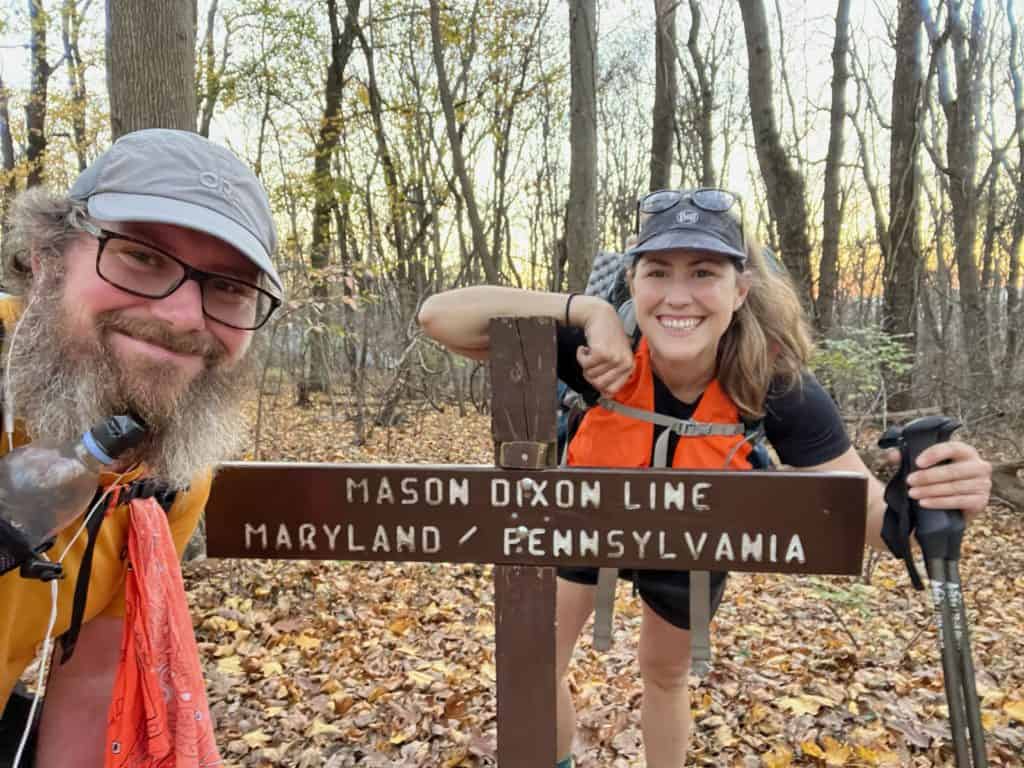
These bright articles of clothing do a great job of making you stand out while hiking through a hunting area.
While it is only recommended to wear the hat and vest when you are in a hunting zone, we were hiking so fast by that point that we opted to finish the fall portion of our hike wearing our blaze orange daily, so we didn’t have to keep track of when we were entering and leaving hunting zones.
We figured this was not something to mess around with and that it was best to play it safe.
Bear in mind, hunters are also playing it safe and paying close attention while hunting. You should not be fearful.
We felt mistakes can always happen, so being as prepared as possible was smart.
Do you need to pack any permits while thru-hiking the Appalachian Trail?
For the majority of your thru-hike, no permits will be required. The only exceptions are when you’re hiking through Great Smoky Mountains National Park, Shenandoah National Park, and on the day you summit Mount Katahdin in Baxter State Park.
✅ Great Smoky Mountains National Park: Before arriving at GSMNP, you must apply for their Appalachian Trail Thru-Hiker Backcountry Permit.
You can obtain the permit online up to 30 days before arriving at Great Smoky Mountains National Park. Once you have received the permit, you will also need to print it in a trail town before arriving at the park.
The permit will last 38 days from the date acquired, giving you eight days to hike through GSMNP. Each permit costs $40. Find more details on GSMNP’S Appalachian Trail Thru-Hiker Backcountry Permit here.
✅ Shenandoah National Park: You must fill out a Backcountry Camping Permit form at the park’s entrance. No fee is required for this permit.
✅ Mount Katahdin in Baxter State Park: All Appalachian Trail thru-hikers must obtain a free A.T. Hiker permit card, in person, at the Katahdin Stream Campground Ranger station before attempting to summit Mount Katahdin. Find more details on the Baxter State Park A.T. Hiker permit card here.
✅ AT Thru-Hike Registration: If you choose, you can register your thru-hike start date with the ATC to help them manage the impact of the hiker bubble. Find more details on ATC thru-hiker registration here.
What does ultralight backpacking vs. lightweight backpacking mean?
To explain this, I first need to explain what base weight means.
Base weight is the total weight of everything in your pack minus consumables.
Consumables include food, water, and fuel. They are omitted because their weight fluctuates day by day.
A lightweight backpacker has a base weight of 10-20 lbs.
An ultralight backpacker has a base weight of up to 10 lbs.
A conventional (or traditional) backpacker’s base weight is anything above either of those options.
Barrett and I would be considered conventional backpackers who, whenever possible, tried to be lightweight backpackers.
In the end, hygiene and comfort got us.
But by skipping a few luxuries like sleep or hygiene items, or extra clothing, you could easily move into the lightweight backpacker category.
How long does an AT thru-hike take?
On average, it takes 5-7 months to complete a thru-hike of the Appalachian Trail, but some people do it at a much faster or slower pace.
How fast do you want to go?
When we started planning, everyone told us we would finish this hike in six months or less. I now understand there’s much more at play when answering this question, and honestly, many uncertainties are involved. You can read more on this topic here.
Can someone accomplish a thru-hike of the Appalachian Trail with no experience?
Yes! I’m living proof that successful thru-hikers can exist with no experience!
Before our thru-hike, we had taken weekly test hikes and one three-day shakedown trip.
I also took a backpacking class in college and grew up car camping.
Then my husband and I lived out of an RV for three years, which had almost nothing in common with thru-hiking whatsoever.
How can I prepare for the Appalachian Trail?
Strength training at least three months before you leave is a great way to set yourself up for success. If you can do more, do even more.
I was worried about being able to make it with 30+ lbs on my back. Strength training beforehand gave me a leg up in that area.
I used Quadzilla’s training guide, available here, as a starting point, but ultimately I reworked it into a plan that worked best for me. Email me if you’re interested in the strength training plan I used leading up to our taking off.
How often should I change gear on an AT thru-hike?
You’ll want to swap out gear as the temperature changes with the seasons.
If anyone at home can help you facilitate these swaps, that would be helpful to arrange in advance.
How did you watch for changing weather conditions?
Early in our thru-hike, I was given the trail name “Radar” because I obsessively monitored and timed our day around the weather.
Eventually, other thru-hikers started coming to me for all of their juicy weather goss.
I kept an eye on weather conditions almost entirely through the MyRadar app.
Their radar maps, weather alerts, and precipitation models were extremely helpful and generally more accurate than those of their competitors.
There is also strong word of mouth about weather concerns all along the trail.
When should I start the AT?
There are many choices for when and where to start your Appalachian Trail thru-hike. Before answering, consider:
How many people do you want to be hiking with?
Most AT thru-hikers start a NOBO hike (in Georgia) in early spring during what is known as the hiker “bubble.” If you want the most social experience, this would be the best time to start.
You can use the thru-hiker registration chart on the ATC website to see when other hikers are starting their treks.
If you are looking for a quieter journey but still want to hike NOBO, I recommend starting before or after the bubble. It’s also worth pursuing a Flip-Flop or SOBO hike instead of a NOBO hike.
To better understand thru-hikers patterns, check out Raincrow’s “Where Are The Hikers?” heat map to get a general idea of where hikers are usually located throughout the year.
Which seasons do you prefer to hike in?
Ask yourself what temperatures you’re least interested in encountering and proceed accordingly.
A traditional NOBO hike starting in early spring will avoid most of the winter season.
However, you can always structure a thru-hike to avoid other seasons if desired and still complete the entire trail within a twelve-month period, which is what’s entailed to be considered a thru-hiker.
Are you attached to one spot as the finish line?
When we started NOBO, my husband was VERY attached to ending at Mount Katahdin.
However, as we hiked and learned more about our pace and preferences, the prospect of ending at Katadhin became increasingly stressful.
Barrett eventually realized what was most important was hiking the whole thing; it didn’t matter to him where we finished.
When we reached Harper’s Ferry, WV, we flipped up to Maine and were immensely happier for the rest of our Flip Flop hike back to West Virginia!
You have many more start date options for your thru-hike if you can let go of the idea of a specific finish line.
Suppose you’re still attached to the idea of ending at Mount Katahdin, though. Then you should start your own hike early enough (between February and April, depending on your hiking pace) to reach Mount Katahdin before it closes for the season. It generally closes in mid-October, but the weather ultimately decides the date every year.
👉 Click Here to Get My Free Appalachian Trail Gear Packing List for Thru-Hikers
Continue Reading:
– SHELTER
– SLEEP SYSTEM
– BACKPACK
– CLOTHING
– FOOTWEAR
– FOOD, COOKING GEAR, & WATER TREATMENT SYSTEM
– SAFETY & REPAIR ITEMS
– ELECTRONICS, NAVIGATION, HYGIENE ITEMS, & BUG MANAGEMENT
– PERSONAL LUXURY ITEMS
– FAQS
